Window & door planning
Hopper Window Planning: Inward Clearance in Poinciana, Florida
Learn how a hopper window opens inward, check room clearance and access, and review ventilation limits and product details before planning.
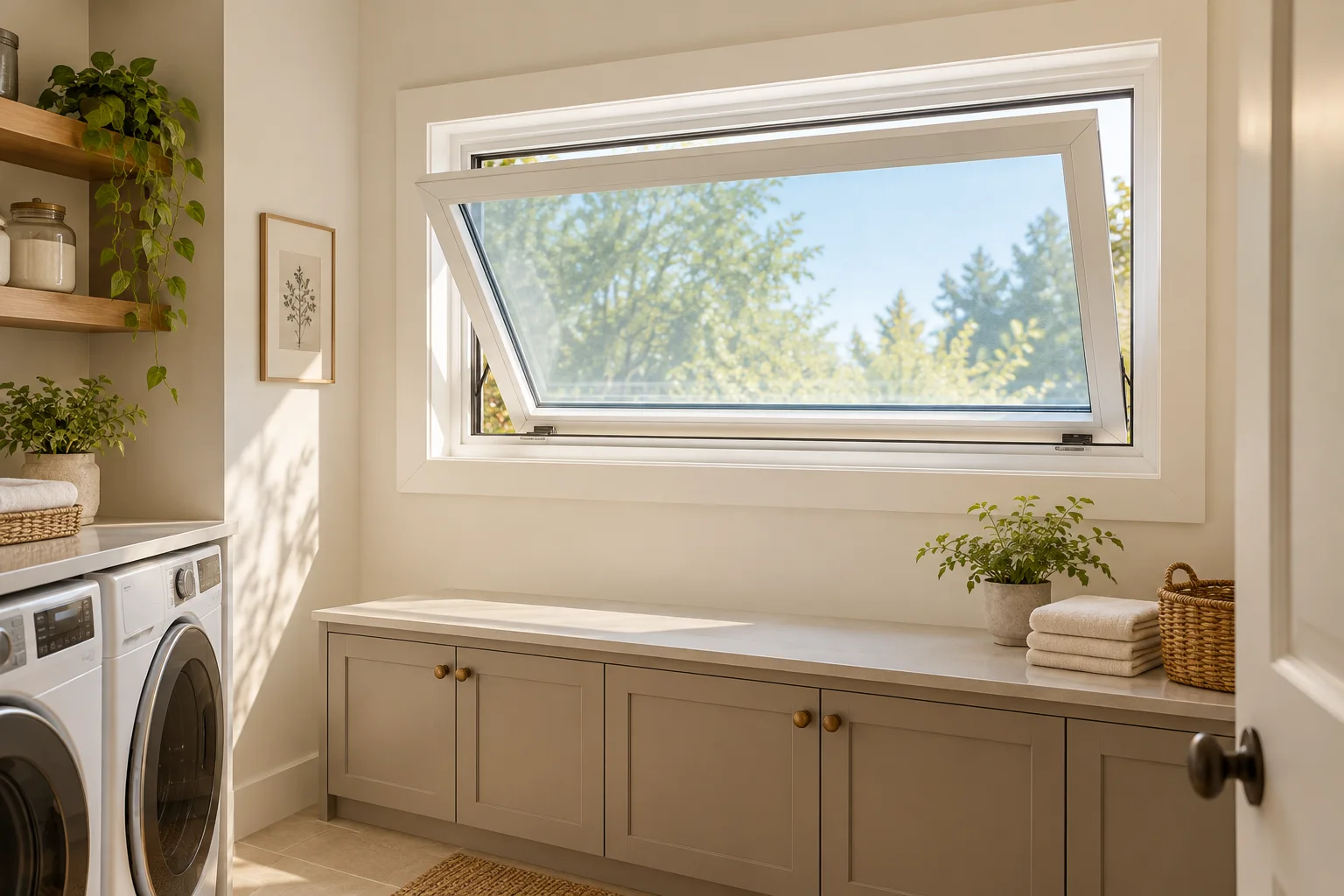
Choosing a hopper window means considering more than the shape of the glass. Its sash tilts inward from the top, so it needs room to move, while the handle and hardware need to remain accessible. In Poinciana, Florida, these checks can help you assess an existing opening or plan questions for a project. The right choice depends on the room and exact product, not the style name alone.
This guide explains how a hopper’s inward movement differs from an outward-opening awning window, what to check around the sash, and why an open window does not guarantee useful ventilation in every condition. You’ll also learn what to gather before discussing a project: opening photos, product labels and questions about operation, fit and product instructions. These steps help you focus on practical details without assuming one product suits every opening.
Key Takeaways
- A hopper window has a bottom-hinged sash that tilts inward at the top, making room-side space part of planning.
- Check sash travel, handle reach, coverings, and screen and hardware access against the actual room.
- An open window offers a potential ventilation path, but weather and outdoor air quality affect its usefulness.
- Opening photos, product labels, and exact instructions help focus questions about fit, operation, inspection, and maintenance.
What Is a Hopper Window?
A hopper window has a bottom-hinged sash—the moving glazed part—that tilts inward at the top. That movement uses room-side space, so nearby objects and access to the handle and hardware matter.
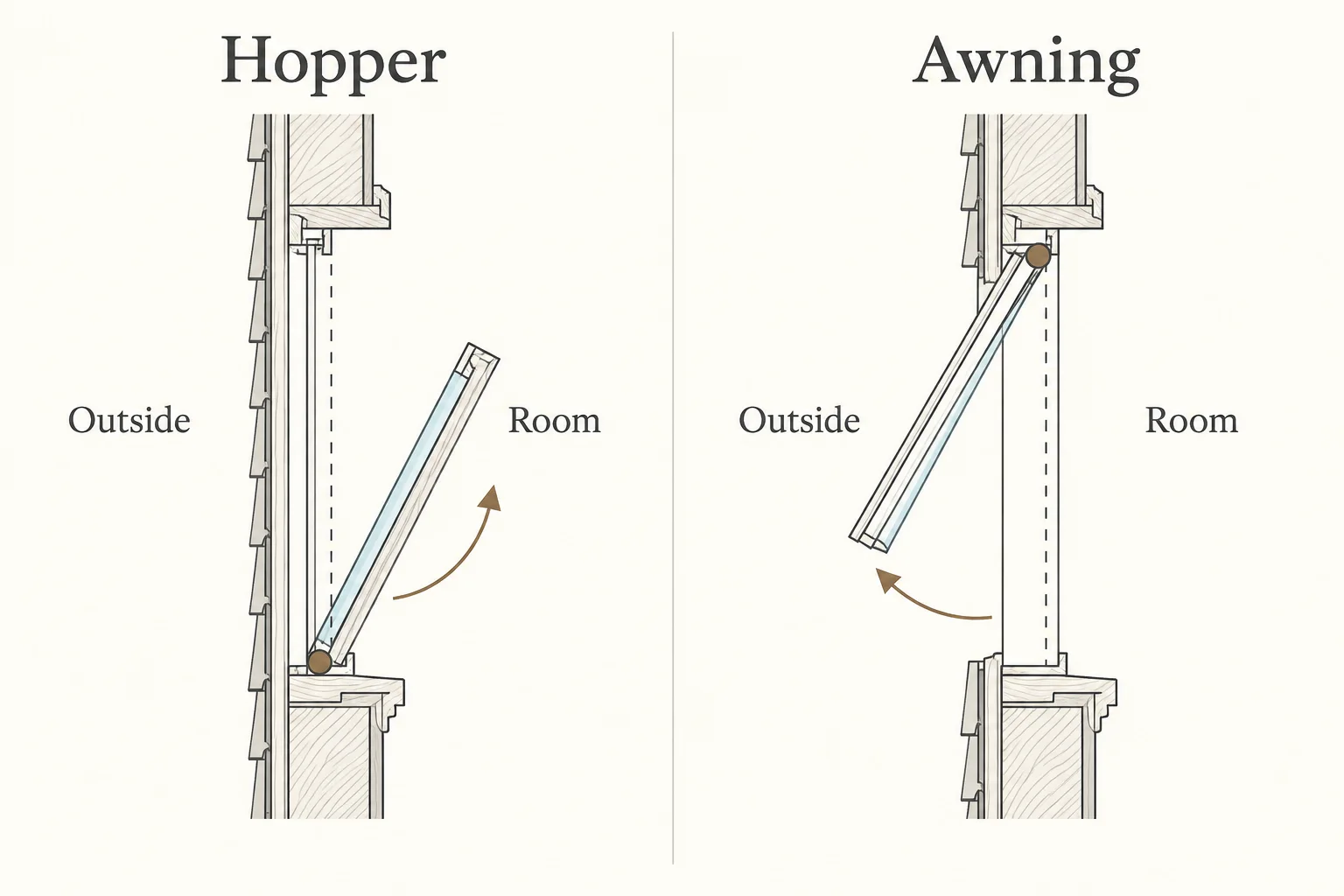
An awning window differs in its basic geometry: its sash is hinged at the top and opens outward. Style names alone do not establish a particular unit’s operation or requirements. Check the product label and documentation for the exact unit.
Check Room Clearance and Operating Access
The key planning difference is the direction the sash moves. A hopper window’s bottom-hinged sash tilts inward at the top, while an awning window’s top-hinged sash opens outward. With a hopper, objects and coverings inside may affect the sash’s path; with an awning, the space outside is relevant. Neither style name alone tells you whether a particular unit suits an opening.
Imagine a shelf beside a laundry-room opening. If it sits in the path of an inward-moving sash, it could interfere with opening. This hypothetical is a prompt to inspect the room, not a claim about a particular home or a prescribed clearance. Look at the whole travel path, then confirm the exact unit’s movement and instructions.
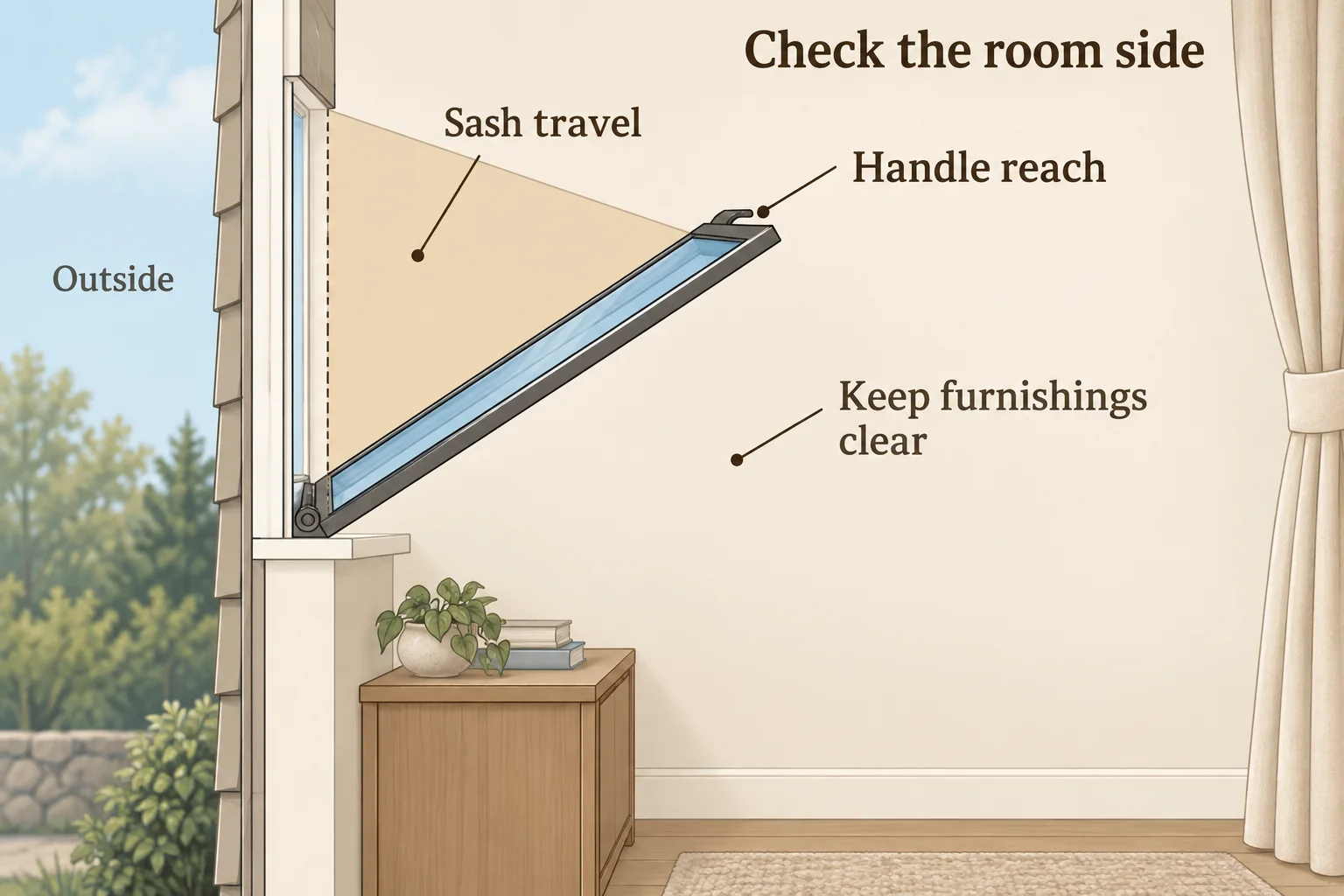
Use this table to spot possible room-side conflicts. It offers questions for planning, not required measurements or manufacturer clearance specifications; the actual product instructions govern its operation and access.
| Check | What to look for | Question to resolve |
|---|---|---|
| Sash travel | Shelves, counters, or objects near the inward path | Could anything interfere when the sash opens? |
| Handle reach | Whether the operating handle is reachable | Can you reach and operate it comfortably? |
| Coverings | Blinds or curtains near the sash | Could a covering interfere with opening or closing? |
| Screen and hardware access | Whether the screen, locks, and operating parts can be reached | Can you inspect and access these parts as instructed? |
Separate Ventilation from Weather and Safety Needs
An open window creates a possible path for air; it does not promise cooling, drying or steady airflow. The U.S. Department of Energy explains that natural ventilation works best with conditions such as cool nights and regular breezes. It cautions against natural ventilation when outdoor air quality is poor. Temperature, humidity and air movement vary, so consider current conditions rather than assuming a window style will produce a particular result.
Keep ventilation separate from emergency-exit suitability. Andersen distinguishes ventilation from emergency-opening requirements, but the style name alone cannot establish whether a particular product and opening are suitable. If that use matters to your project, check the exact product and applicable requirements rather than inferring an answer from “hopper.”
Prepare Product and Opening Details
Gather photos that show the opening and the nearby room, plus any label or paperwork for an existing window. These details can make questions about the opening and product more concrete; a photo or style name alone cannot confirm fit or suitability.
Ask about the exact model and size, how its sash travels, and how to inspect the screen, locks and operating hardware. Also ask which installation method and maintenance instructions apply to that specific product. Requirements can differ between products, so do not assume one set of instructions or dimensions applies to every hopper window.
For example, ProVia’s instructions apply to specified vinyl hopper products, not every hopper. They call for checking unit size against the opening and inspecting the frame, glass, screen and hardware. They also warn against blocking the product’s weep holes, which must remain open for drainage. Treat this as a reason to consult the instructions for the exact product, not as a general installation procedure.
When a project is complete, follow the product’s own inspection and maintenance guidance. Confirm that the sash and hardware operate as instructed and that any specified drainage paths remain clear.
FAQs
What is a hopper window?
A hopper window has a bottom-hinged sash that tilts inward at the top. Its room-side movement can affect nearby objects and access to the handle, screen and hardware. Check the label and documentation for the exact unit, since a style name alone does not establish its operation or requirements.
What should I check before choosing an inward-opening hopper window?
Check the sash’s inward path, nearby furniture or shelves, handle reach, coverings, and access to the screen and operating hardware. These are practical planning checks, not universal clearance measurements. Confirm the actual product’s requirements rather than relying on a generic window-style description.
Will a hopper window ventilate a room or serve as an emergency exit?
Not on its own. Natural ventilation depends on conditions such as outdoor air quality, temperature and air movement. An open window creates a potential air path, but does not guarantee cooling or drying. If the opening may need to serve as an emergency exit, check the exact product and opening requirements separately.
Conclusion
A hopper window’s inward travel makes room-side clearance and access important, while useful ventilation depends on conditions beyond the window style. Exact product documentation can answer questions about fit, operation and maintenance.
Before discussing your project, gather photos of the opening and any product label. Note nearby shelves and coverings, then call Windows and Doors by Martin Toro and ask about your project.