Window & door planning
Window Weep Holes: Care in Orlando, Florida
Window weep holes route water out of some window frames; learn how to identify accessible drains, clean them gently, and respond to persistent indoor leaks.

Water in a window sill can look like a leak, but some windows are designed to hold and drain water through small openings at the bottom of the frame. These openings, often called window weep holes, vary by product, so a visible puddle does not show on its own whether something has failed. For homeowners in Orlando, Florida, start by identifying the window and understanding its intended drainage path—not by drilling a hole or assuming it needs replacing.
This guide explains where drainage openings may be, how to clear accessible debris without damaging the unit, and what signs call for further assessment. You’ll also learn what details to record if water keeps appearing indoors, giving a professional useful context instead of a guess.
Key Takeaways
- Window weep holes are drainage openings on some windows that let water in a frame or track flow outdoors.
- Opening locations differ by window, so identify the product and its instructions before deciding a visible hole is blocked.
- Use gentle, product-specific care to clear known accessible debris; avoid pressure washing or drilling new openings.
- Persistent indoor overflow or visible damage deserves assessment, while temporary sill water alone does not prove failure.
What Are Window Weep Holes?
Window weep holes are drainage openings on some window designs that let water in the frame or track exit outdoors. They may appear as small slots along the exterior bottom frame, with water entering the drainage path from inside or beneath the track.
A sill is the window’s bottom ledge; a track is the channel where a moving sash travels. Designs vary, so openings are not always visible or in the same place. The U.S. Department of Energy’s Pacific Northwest National Laboratory describes openings on exterior bottom frames and in or beneath some tracks.
This route is part of the window’s design, not proof that it is waterproof. Andersen notes that water can remain temporarily in some sills after heavy rain while drainage takes time. A puddle alone does not establish failure; follow the product’s instructions and watch for continuing indoor overflow.
Understand the Drainage Path
A drainage system gives water that enters parts of an equipped window a route outdoors. On some models, a small exterior slot is the outlet; water may enter the path inside or beneath the track. The opening visible indoors may not match the exterior outlet.
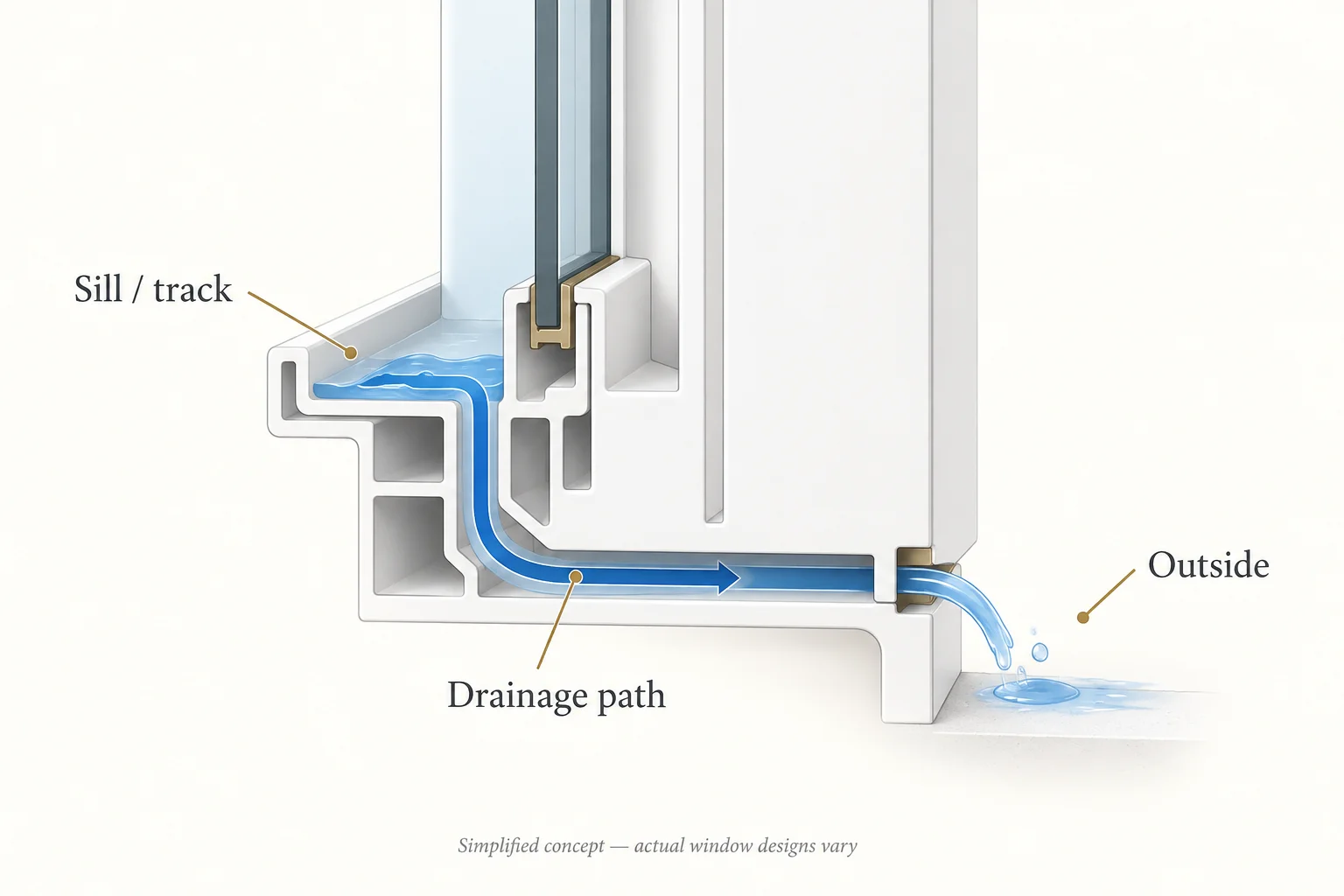
The Pacific Northwest National Laboratory guide describes openings in different locations, including the exterior bottom frame and in or beneath tracks. These are examples, not a map for every window.
Look for the product label and match the manufacturer and series to care instructions. Andersen says its label can record details such as series, size and glass information useful when seeking support or parts. Use the product’s guidance rather than comparing it with a different model.
Clean Accessible Openings Carefully
Keep care gentle and limited to openings you can identify as part of your window’s design. Pella’s manual recommends a small soft brush for debris at openings on named product series; it also describes a vacuum brush attachment for loose sill debris. Clear dirt carefully rather than pushing it farther into the frame. Follow your model’s instructions; those directions do not establish a universal procedure.
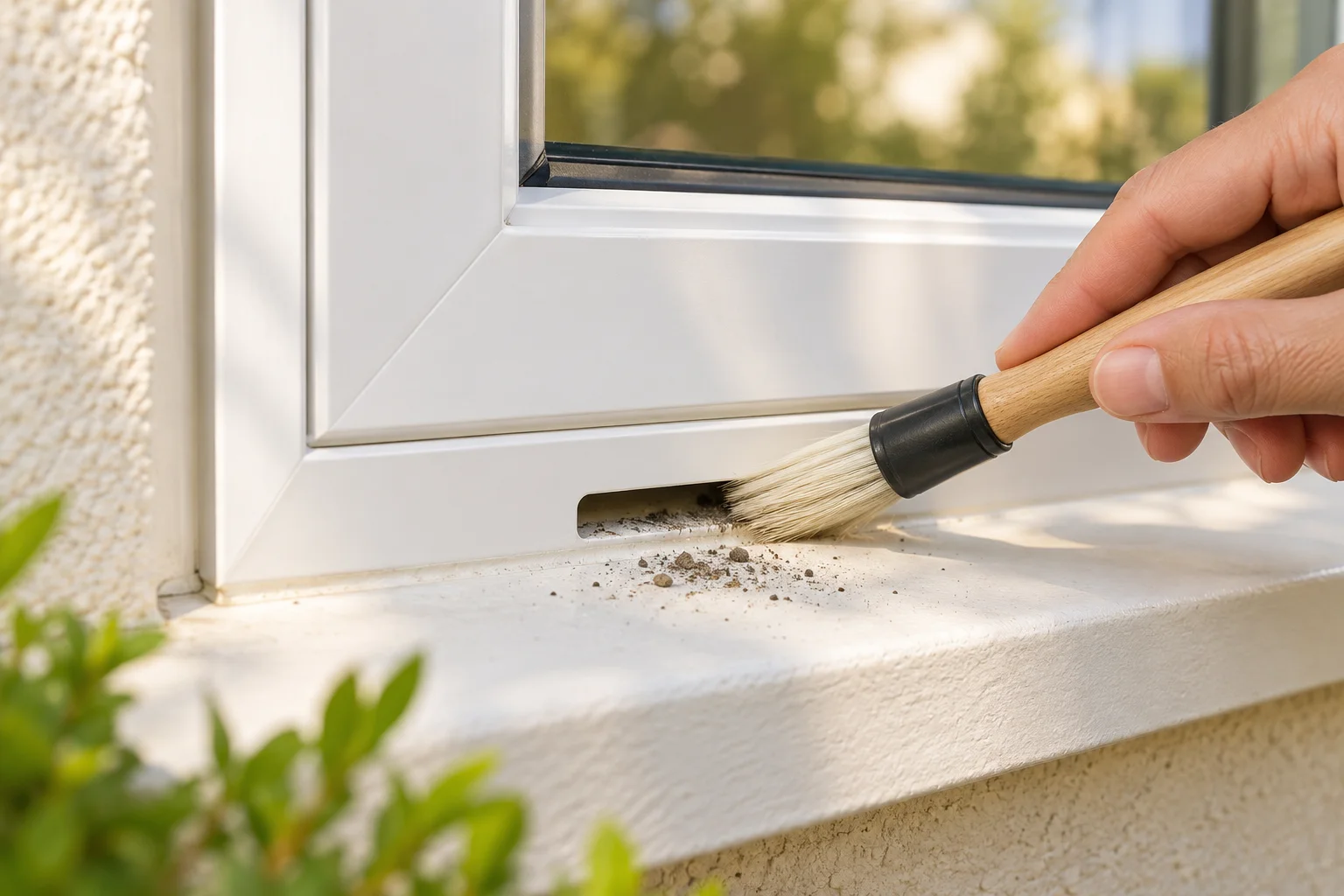
The Pacific Northwest National Laboratory guide describes exterior-only cleaning as an option, rather than requiring track removal. If an opening is inaccessible, a cover’s purpose is unclear, or cleaning would require taking parts apart, consult product instructions or qualified help. Covers may be designed components, not plugs. Do not remove one or drill an opening as a substitute for guidance.
Avoid pressure washing. Andersen warns that pressurized washing can damage window units, and forceful water can overwhelm drainage. After cleaning, follow the product’s instructions for any further check; there is no single drain-time test for every design.
Know When Water Needs Further Assessment
Choose the next step according to what you observe, not a remote diagnosis. Andersen distinguishes temporary water in some sills from situations that warrant checking for debris. A forensic engineer describes drainage failures that can lead to indoor overflow and nearby material damage, but those signs do not prove the cause in an individual home. They also do not establish that a window needs replacement.
| What you observe | Practical next step |
|---|---|
| Water remains temporarily in a sill after rain, with no confirmed blockage. | Check product drainage and care instructions; do not assume failure from a puddle alone. |
| Debris is visible at an opening identified as a drain. | Follow model-specific care guidance and gently clear accessible debris. |
| Water keeps overflowing indoors or nearby trim or wall materials appear damaged. | Record the symptoms and seek an assessment of the window and surrounding area. |
For an assessment, note the product label if accessible, where and when water appears, whether the issue repeats, and any earlier cleaning. Photos of the opening and visible damage can help describe your observations. These are prompts, not a diagnosis or promise of a particular repair. A qualified professional can assess the cause before you decide what work is needed.
FAQs
Do all windows have visible weep holes?
Not necessarily. Some windows have small openings positioned in or beneath a track, or openings that are not visible from inside. Designs vary, and not every window uses identical drainage openings. Check the manufacturer’s product information or care instructions before assuming a hole is missing or blocked. Do not drill a new opening to imitate another window’s design.
Is water in a window sill always a sign of failure?
Not by itself. Andersen notes that water may remain temporarily in some sills after heavy rain while the designed drainage path discharges. Check the product-specific instructions and observe whether water exits or continues to overflow indoors. If indoor leakage persists or nearby materials appear damaged, arrange an assessment rather than diagnosing the cause from a puddle alone.
What is a safe way to clean a window drainage opening?
Use the manufacturer’s instructions for your specific window; limit cleaning to an identified, accessible opening and avoid disassembly unless those instructions allow it. If you are unsure how to reach an opening or whether a cover should move, seek product-specific guidance or qualified help.
Conclusion
Drainage openings are part of some windows’ design, but a puddle alone does not show whether the window has failed. Start with the product label and care instructions, then note where and when water appears. If water keeps overflowing indoors or nearby materials look damaged, ask a qualified professional to assess the window and surrounding area before deciding what work is needed.