Window & door planning
Energy Efficient Window Replacement in Winter Garden, Florida
Compare energy efficient window replacement options by reading U-factor, SHGC and VT, weighing room exposure, and checking product and installation details.

When comparing energy efficient window replacement options, do not look for one rating that declares a winner. Start by asking what each rating measures, how proposed glass packages differ, and whether those differences fit the sun, shade and daylight in your home. A sunny room and a shaded room may call for different balances. This guide explains U-factor, SHGC and VT, then uses a clearly hypothetical comparison to show how to read a proposal. You will also see how to connect the differences between two options to your priorities, what room-specific questions can clarify the choice, and which product and installation details to request before choosing a window. Ratings describe product characteristics; they do not tell you what your household’s energy bills will be. Use the comparison as a practical starting point for reviewing written proposals, not as a promise about results.
Key Takeaways
- Window energy ratings describe distinct product characteristics; NFRC enables comparisons, while ENERGY STAR marks qualifying products.
- U-factor concerns non-solar heat transfer, SHGC concerns solar heat entering, and VT concerns visible light passing through.
- Compare the exact model and glass package in each proposal, not a marketing label or frame material alone.
- Room exposure, existing shade and daylight priorities help shape the questions to ask about a window package.
What Is Energy Efficient Window Replacement?
Energy efficient window replacement means choosing replacement windows by comparing documented product performance with the conditions and priorities of each room. NFRC ratings help compare specific product characteristics; the ENERGY STAR label identifies products that qualify for its program. They serve different purposes, so neither label is a single overall score.
The main ratings describe different effects: heat transfer, solar heat entering and visible light passing through. A lower or higher number can be preferable depending on the rating and what a room needs. Ratings also assume proper installation, so the proposed product is only part of the comparison.
Separate Solar Heat, Insulation and Daylight
Use the table as a reading guide: first identify the rating name, then interpret its number in that rating’s own direction. That prevents confusing a preference for more daylight with a preference for less solar heat.
| Rating | What it describes | Direction to compare |
|---|---|---|
| U-factor | Non-solar heat transfer through the product | Lower means better insulation |
| SHGC | Solar heat entering through the product | Lower means less solar heat transmitted |
| VT | Visible light transmitted through the product | Higher means more visible light admitted |
| Air leakage (AL) | Air passing through product joints | Lower means less air leakage |
| ENERGY STAR | Program qualification for a product | Check whether the product qualifies for the relevant region |
| NFRC ratings | Standardized performance information for comparing products | Compare documented values for the specific products |
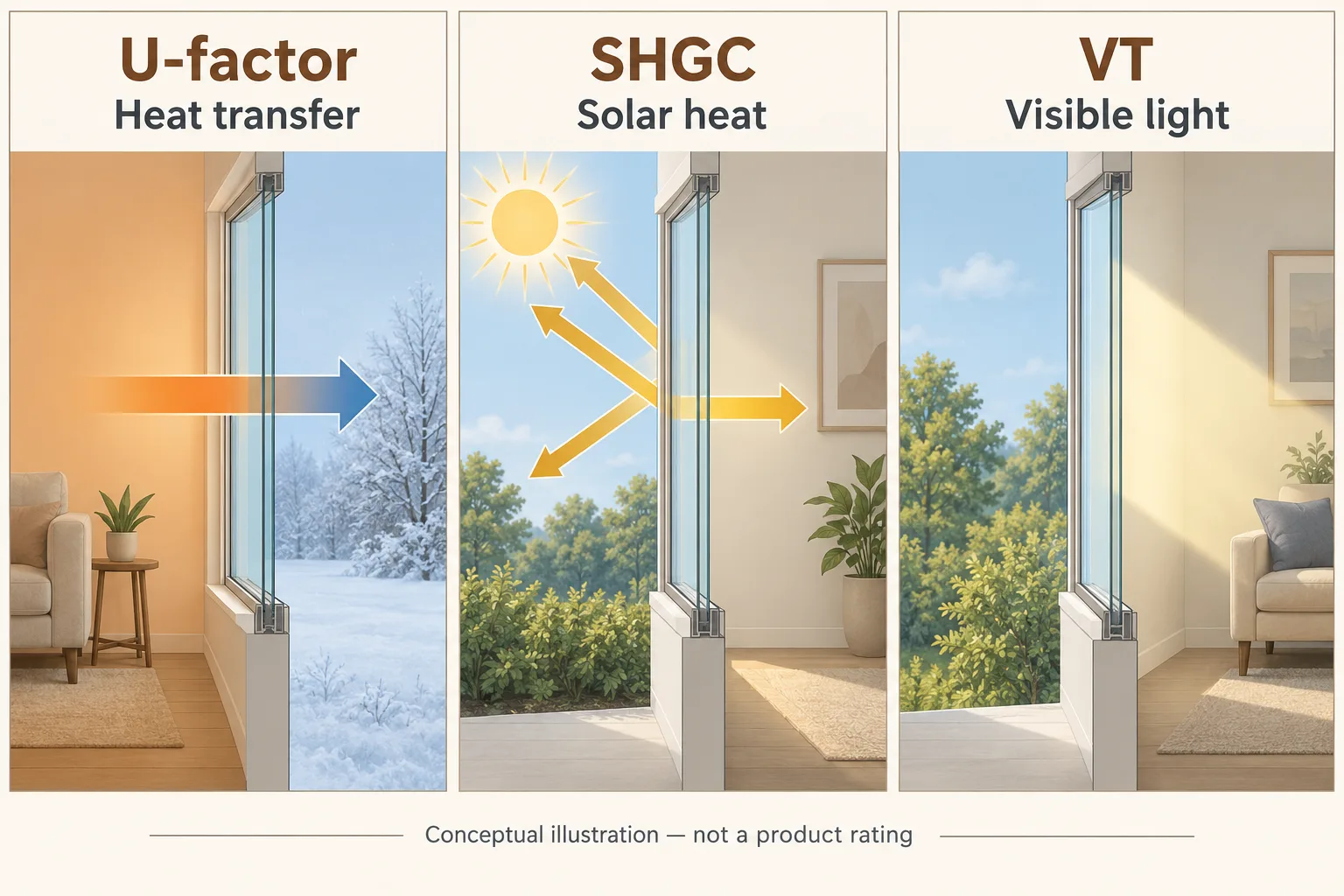
A lower number is not universally better: that direction applies to some ratings, while VT works in the opposite direction. Air-leakage information may not appear on every NFRC label because its display is optional. Check the rating name and proposed product together.
Compare the Exact Window Packages
Compare the exact proposed window model and glass package rather than assuming a material name or Low-E description settles the decision. Panes, gas fills, frames, spacers and coatings work as a system, so request documentation for the complete product being quoted.
Imagine two hypothetical options with the same U-factor but different SHGC and VT values. Option A has a lower SHGC and lower VT; Option B has a higher SHGC and higher VT. Neither is automatically superior. The first admits less solar heat and less visible light, while the second admits more of both. These invented values illustrate a tradeoff only; they are not product recommendations, available products or local targets.
Once you see that tradeoff, decide which difference you want the proposal discussion to resolve: admitting less solar heat, preserving more visible light, or balancing the two. Ask the installer to explain how the documented options address that priority, rather than relying on a broad efficiency label.
Match the Choice to Each Room
A room’s exposure and existing shade can change which tradeoff deserves attention. Consider two planning situations: a room that receives direct afternoon sun, and a shaded room where preserving daylight is a priority. These examples help frame questions; they do not diagnose a room or predict a temperature change.
In the sunny room, ask how the proposed SHGC relates to the solar heat you want to admit, and whether existing shade changes the situation. In the shaded room, ask how the glass package balances solar heat with the visible light you value. In warmer climates, lower SHGC and shading can matter on sunny exposures, but that principle is not a universal numerical target for every window.
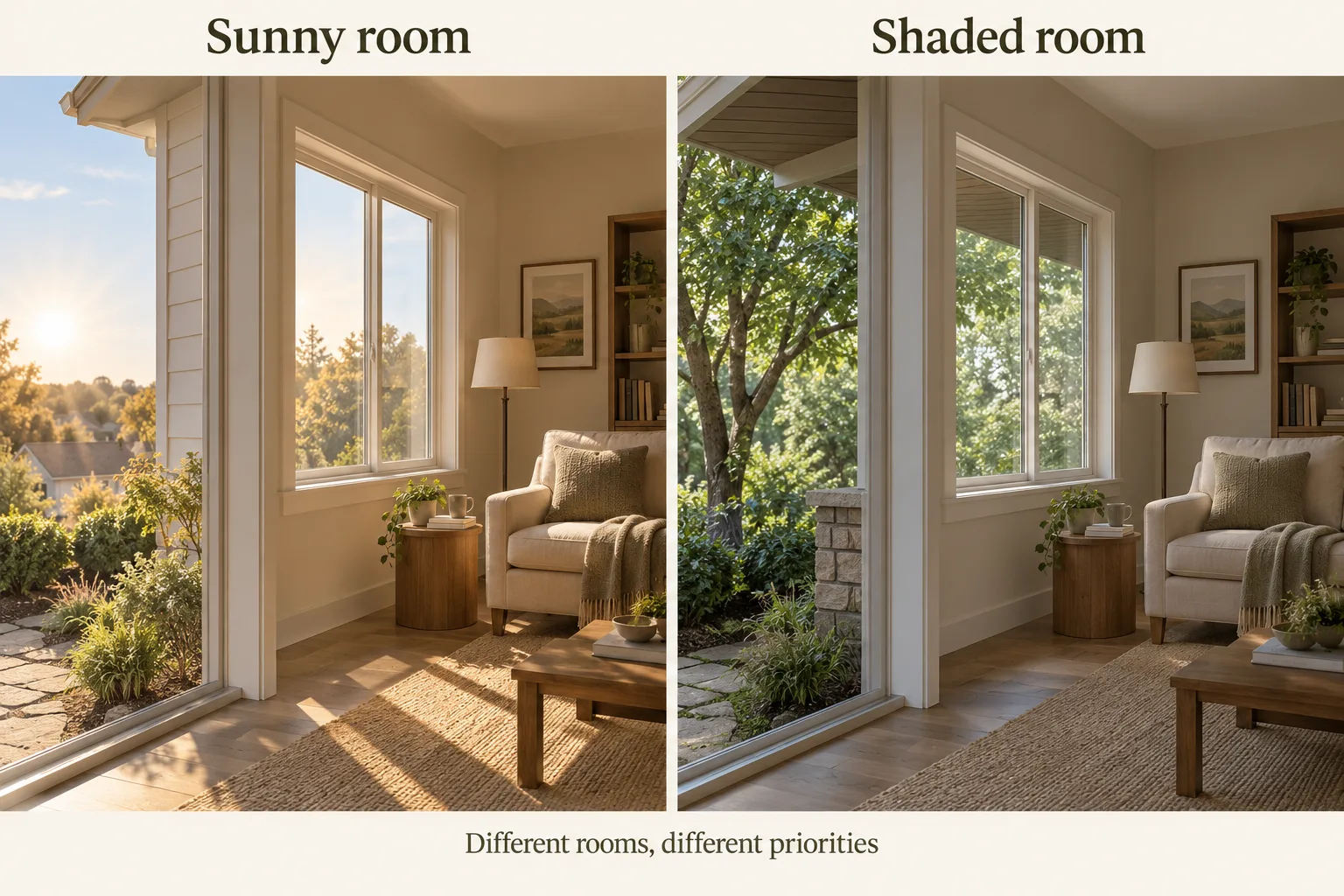
Note which rooms receive direct sun and when, along with overhangs, trees or other existing shade. Share those observations when comparing options. The practical question is not simply which package has the lowest number; it is which documented differences match the room’s exposure and your priorities.
Check Installation and the Written Proposal
Product ratings assume proper installation, so ask for installation scope as well as product details. Manufacturer installation instructions should be followed, and the proposal should make clear what work is included rather than leaving the product label to stand in for the whole job.
Before choosing, check that each proposal identifies the window model and glass package, supplies rating documentation for that specific configuration, and describes the installation scope. If one quote names a product family while another gives an exact configuration, request enough detail to compare equivalent options. That is more useful than comparing broad phrases such as “energy efficient” on their own.
If a proposal leaves a rating or installation detail unclear, ask the installer to identify it in writing before you compare the scope.
FAQs
What Is the Difference Between NFRC Ratings and ENERGY STAR?
NFRC ratings provide a way to compare window-product performance across defined measurements, including U-factor, SHGC and VT. ENERGY STAR identifies products that qualify for its program in specified regions. The labels are complementary: one helps you compare documented product characteristics, while the other signals program qualification. Neither tells you by itself which window is right for every room.
Do Window Energy Ratings Predict How Much I Will Save?
No. U-factor, SHGC, VT and air leakage describe tested product characteristics; they do not forecast a household’s energy bills. Compare the documented ratings for the exact product and review its installation scope when considering proposals.
What Should I Ask a Window Installer About Energy Ratings?
Ask the installer to explain how U-factor, SHGC and VT describe different aspects of the proposed window. Then ask which of those differences relates to your main priority, such as admitting less solar heat or preserving daylight. This can help you understand the tradeoff without treating any single rating as an overall score.
Conclusion
Treat the ratings as separate clues, then compare the complete window packages against each room’s needs. A lower U-factor, lower SHGC or higher VT is not automatically the best choice everywhere; the useful balance depends on exposure, shade and daylight priorities.
Once the product details and installation scope are clear, make your choice based on the documented performance that fits your priorities. Treat any unresolved proposal detail as a question to settle before moving ahead.
Discuss your room priorities and proposed window specifications with our replacement-window team.