Window & door planning
Door Handing and Swing in Altamonte Springs, Florida
Separate hinge side and swing from product codes, record your viewpoint and match door, frame or hardware details to the exact manufacturer chart.
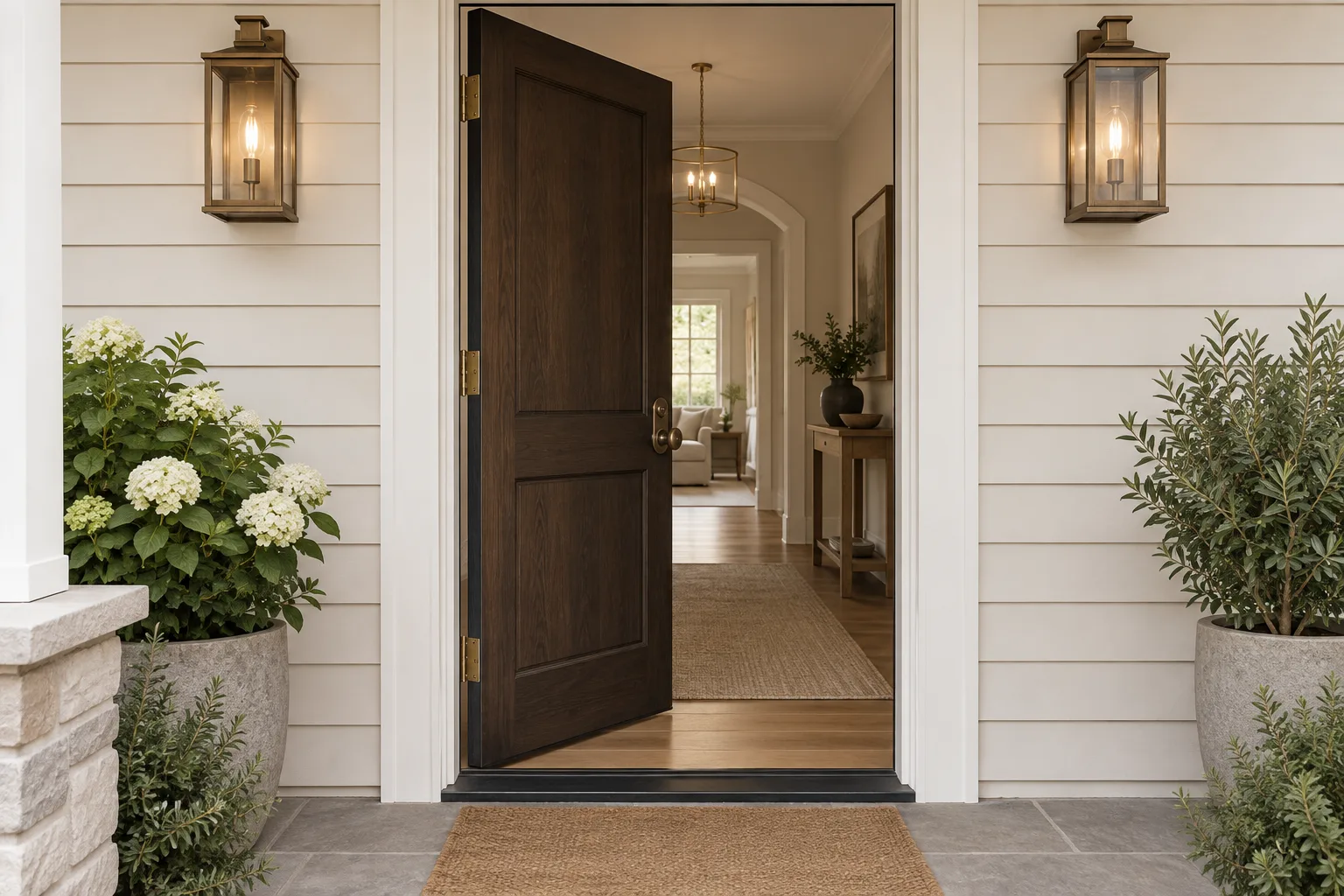
If you’re ordering a door or hardware, choosing “left” or “right” may seem simple—until a chart uses a different viewpoint or lists the frame separately. Door handing describes orientation, but the term alone doesn’t tell you whether the door swings inward or outward, or which code a particular item needs. In Altamonte Springs, Florida, start by recording what you can observe and where you stand, then consult the manufacturer’s chart for the item being ordered.
This guide separates hinge position from swing direction, explains how to read one four-code hardware convention, and shows why door, frame and lever labels may differ. You’ll also find a practical checklist for documenting an opening before ordering. The goal is to compare your observations with the right product instructions—not to assume that one left-or-right label converts across every chart.
Key Takeaways
- Door handing describes a door’s orientation, while swing direction tells whether it opens inward or outward.
- Record your viewpoint with hinge side and swing because apparent left and right can change from the opposite side.
- Schlage’s CS210 chart defines LH, RH, LHR and RHR for a specific hardware convention, not every order system.
- Door, frame and lever labels may differ, so match your notes to the exact item’s instructions.
What Is Door Handing and Swing?
Door handing describes a door’s orientation, including hinge placement and opening direction; swing describes whether it opens inward or outward. The correct order code depends on the exact product and its manufacturer’s convention.
Separate what you can see from the label you need to order. Identify your viewpoint, hinge side and swing, then match those details to the instructions for the door, frame or hardware in question.
Separate Door Handing From Swing Direction
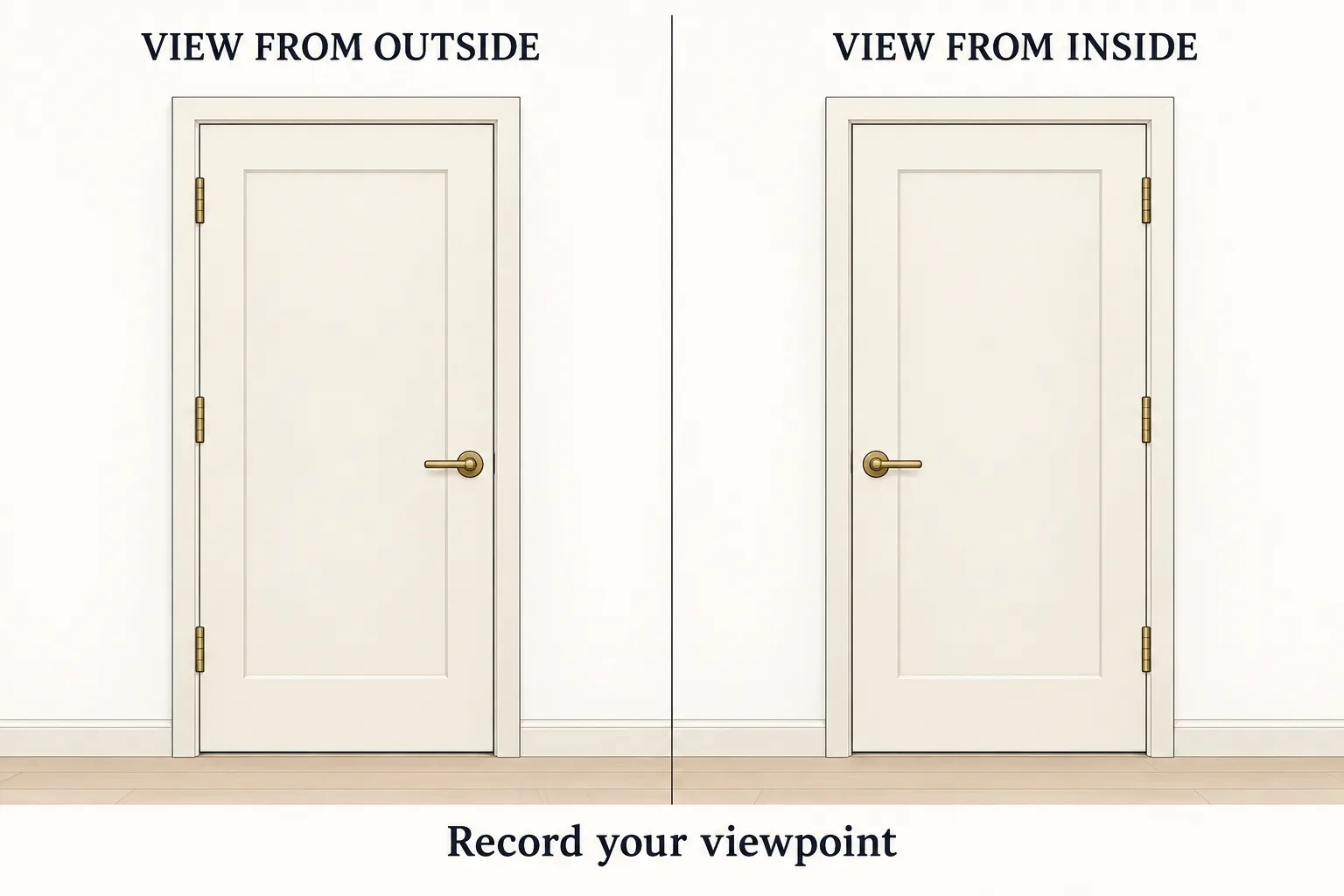
Handing and swing describe related but distinct observations. Sun Mountain’s method is to stand with your back against the hinge jamb—the vertical part of the frame on the hinge side—and note whether the door opens left or right. This is that manufacturer’s method for determining handing, not a universal ordering code.
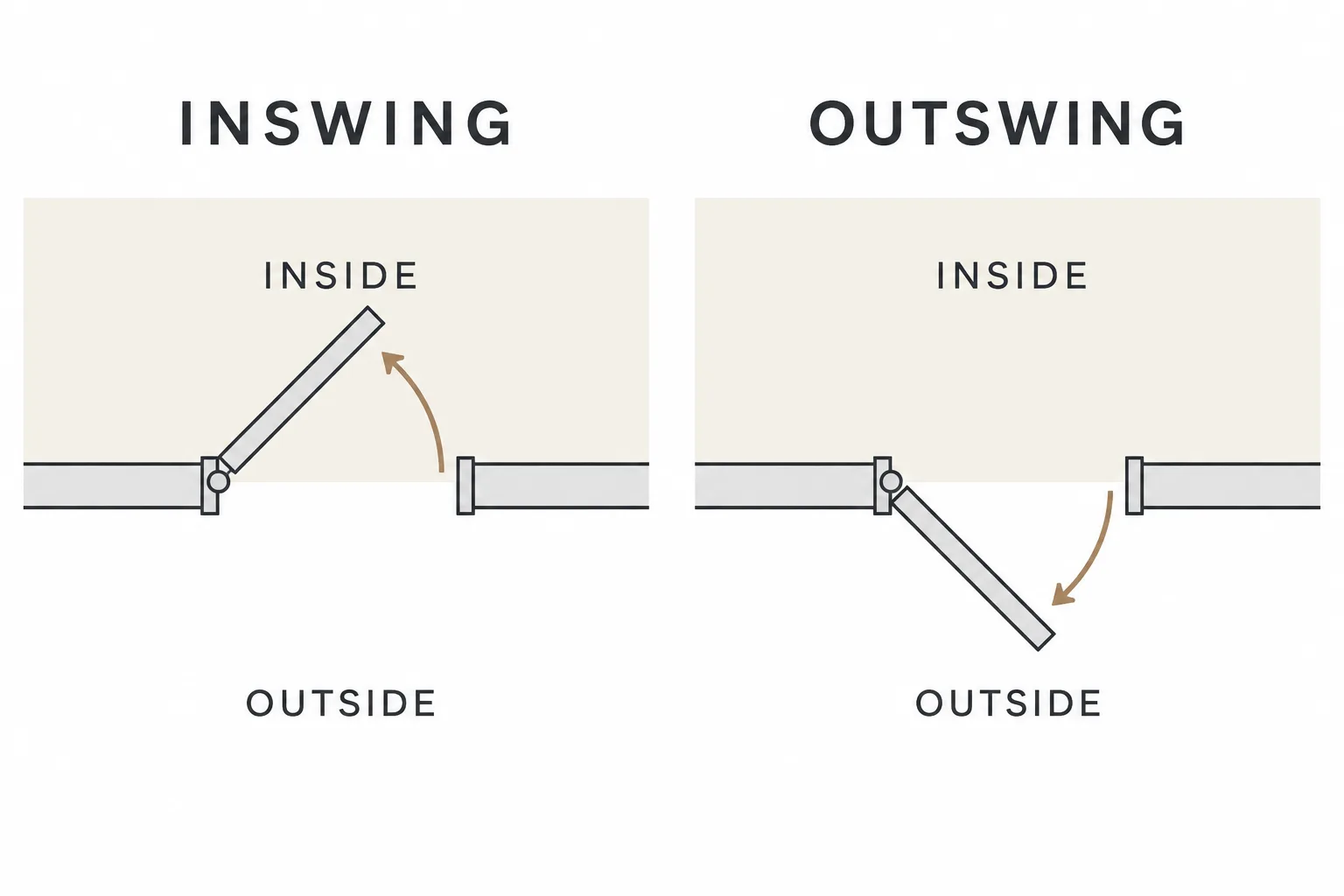
Inswing means the door opens into the room or home; outswing means it opens out. Left and right depend on where you stand: the hinge side that appears on your left from one side can appear on your right from the other. Record the viewpoint along with hinge side and swing, using the position specified in the product instructions. Then consult that product’s chart for its code rather than treating the observations as a code themselves.
Read a Four-Code Hardware Chart
Schlage’s CS210 service manual gives a four-code convention for a person standing on the secure side, usually outside. In this chart, “reverse” means the door swings toward that viewpoint. These codes describe this specific hardware convention, not every door or frame order system.
| CS210 code | Hinge position from secure side | Door moves |
|---|---|---|
| LH | Left | Away from you |
| RH | Right | Away from you |
| LHR | Left | Toward you |
| RHR | Right | Toward you |
Read hinge position and swing together from the chart’s stated secure-side viewpoint. If you switch sides, the apparent hinge position changes, so a bare “left-hand” or “right-hand” description can be unclear. Here, “reverse” distinguishes a door that swings toward the stated viewpoint from one that swings away; it does not change the hinge position in the table. Use these labels to understand the CS210 chart, not as a conversion key for another manufacturer’s door or frame schedule.
Confirm the Door, Frame and Hardware Before Ordering
A door code does not automatically give you the frame code. DKS’s chart, for example, labels a right-hand reverse outswing door with a left-hand frame, and a left-hand reverse outswing door with a right-hand frame. Its double-door charts also identify the active leaf separately. These are DKS conventions, not rules to apply to other products.
Hardware may have its own requirements, too. Schlage notes that some curved levers require a left- or right-hand selection, while certain passage, privacy and keyed levers can be reversed; straight Latitude levers have universal handing. Those are product-specific examples, not a guarantee that a lever can be reversed. Check the instructions for the exact model, and do not substitute a door or frame label for a hardware label.
Before ordering, make a short record:
- The product or model and whether you are ordering a door, frame or hardware.
- Your viewpoint, hinge side and whether the door swings inward or outward.
- For a pair of doors, which leaf is active if the product chart asks for it.
- Photos or a sketch that show the opening, hinge position and your viewpoint.
Compare that record with the manufacturer’s chart for the exact item. Confirm that its viewpoint and terminology match your notes; a door chart may not answer a frame or lever question. If the instructions leave the code unclear, ask the supplier to confirm it rather than guessing at a conversion.
FAQs
How Do You Determine Door Handing?
Start from the viewpoint specified in the product instructions. Note which side has the hinges and whether the door opens toward or away from you; also record whether it opens into the room or out. Then use the chart for the exact door or hardware product. Different manufacturers can use different conventions, so these observations alone do not establish a universal order code.
What Is the Difference Between Inswing and Outswing?
An inswing door opens into the room or home, while an outswing door opens out. Left and right can appear reversed when you move to the other side, so state your viewpoint when describing hinge position. Swing direction and hinge side are observations to record; use the specific product’s instructions to translate them into an order code.
Conclusion
Before ordering, keep your observations separate from the product code: note your viewpoint, hinge side and swing, then check the chart for the exact item. A code from a door chart may not identify its frame or hardware. For your project, call Windows and Doors by Martin Toro and ask about it.