Window & door planning
Window Privacy Film: See Out, Not In? Poinciana, Florida
Compare reflective, frosted, and obscure-glass options to see how window privacy film affects views by room, lighting, and time of day.

Can window privacy film let you see out while keeping others from seeing in? Reflective film depends on the difference in brightness between indoors and outdoors, so its effect can change after sunset. Lighting can reverse the privacy effect. For a homeowner in Poinciana, Florida, the decision turns on when privacy matters and whether a clear outward view is important. This guide explains how day-and-night visibility works and compares reflective film with frosted film and obscure glass. It also offers a practical way to assess your options in the room where you plan to use them. By considering lighting, view preferences and the exact glass, you can judge a product against the conditions that matter instead of relying on a label alone.
Key Takeaways
- Reflective window privacy film is light-dependent, not a permanently one-way barrier.
- A brighter outdoor side may preserve a daytime view out, but a lit room can be visible from outside at night.
- Frosted film obscures views in both directions, while obscure glass is an option to consider during replacement planning.
- Compare the exact product and glass under actual lighting, and confirm compatibility in the manufacturer’s instructions.
What Is One-Way Reflective Window Privacy Film?
One-way reflective window privacy film is a light-dependent treatment that can make the brighter side of a window appear reflective while allowing a view from the darker side. It is not permanently transparent in just one direction. When outdoor light is brighter than indoor light, reflection may limit views into the room while preserving a view out. At night, a lit interior can become brighter than the outdoors, so people outside may see in.
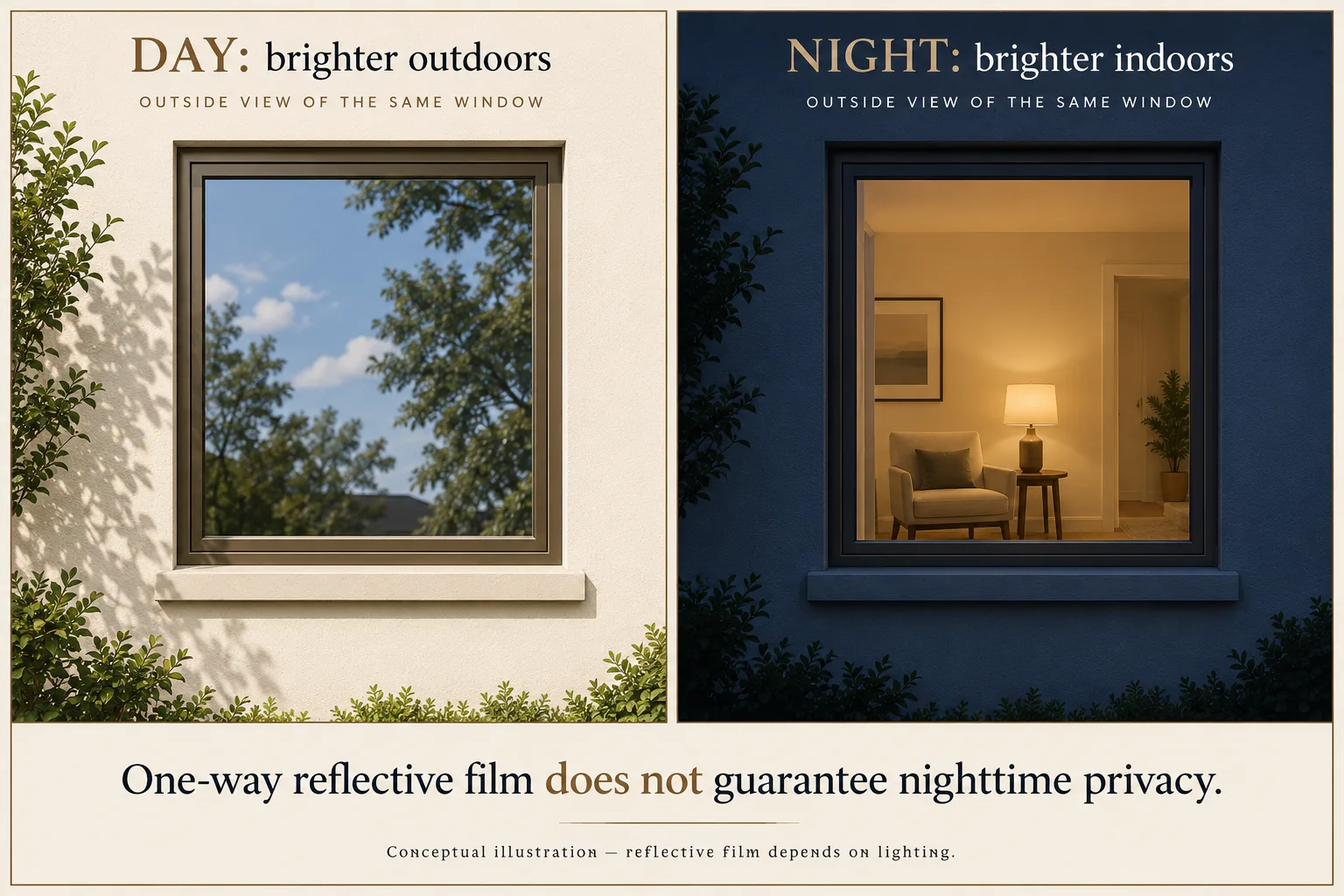
The difference is light, not a one-way glass barrier. SOLYX describes its silver-grey film as providing daytime one-way visibility and notes that interior lights can make a room visible at night. Gila similarly identifies its mirror film as a daytime privacy option. Its frosted film diffuses light but does not provide a clear outward view. These examples illustrate product-specific tradeoffs, not a guarantee for every film or window.
Compare Privacy With the View You Want
Choose a privacy treatment by balancing how much view you want to keep against when you need privacy. Reflective film may preserve a daytime outward view, but its nighttime limit matters. Frosted film trades a clear view for diffused light and obscured views; obscure glass is another option to explore when replacing a window.
| Option | View and privacy tradeoff | When to consider it |
|---|---|---|
| Reflective film | May allow a view out while limiting views in from the brighter side; the effect can change at night. | You want a daytime outward view and can plan a separate covering for nighttime privacy. |
| Frosted film | Diffuses light and obscures views in both directions; the amount of obscuration varies by product. | A clear outward view is less important than obscuring the view through the glass. |
| Obscure glass | Can provide privacy while allowing natural light; textures and configurations vary by product. | You are already considering window replacement and want to review glass options. |
Consider two hypothetical rooms with different priorities. In a home office, someone may value a daytime view and compare reflective film with a separate nighttime covering. In a bathroom, a clear outward view may matter less, so frosted film or obscure glass may be worth considering. Neither example predicts performance in a particular home; compare a sample under actual conditions.
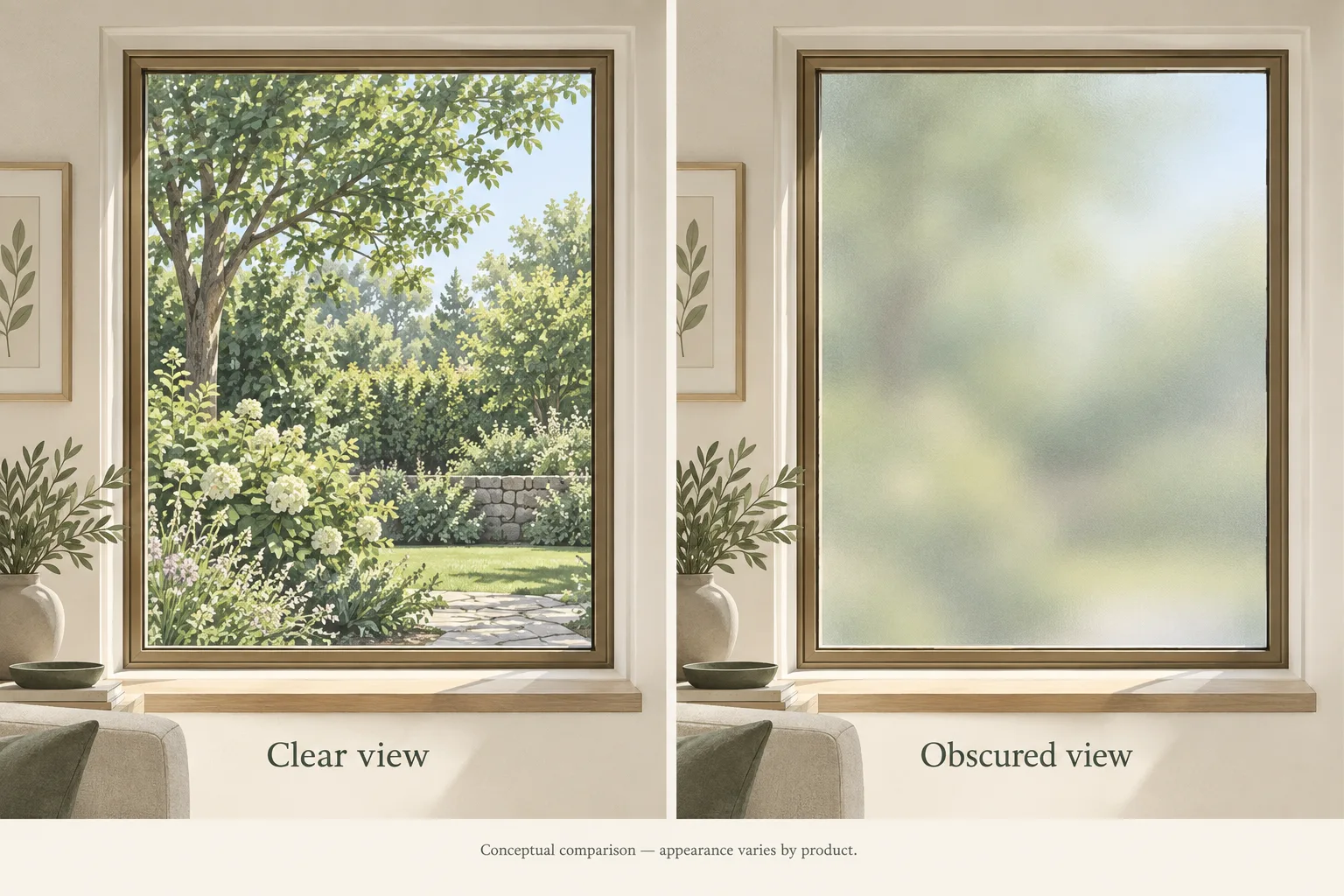
The useful question is what view you want to keep and during which hours you need to limit views in.
Check the Exact Glass and Product Before Deciding
A product description alone cannot show how a film will suit your room’s lighting or window. Manufacturer guidance varies, so check the exact product instructions instead of assuming that one film works with every glass type. If replacement is already planned, ask about available obscure-glass options and review a sample.
Use this planning checklist:
- Note the room and the hours when privacy matters most.
- Decide whether preserving a clear outward view is important there.
- Observe indoor lighting and outdoor brightness during those hours, including after dark.
- Note any existing nighttime covering and whether you would use one with reflective film.
- Compare a sample from both sides under the conditions you expect in the room.
- Check the manufacturer’s instructions for the exact film and glass combination, including any dual-pane guidance.
- If window replacement is already under consideration, ask which obscure-glass options are available and review a sample.
FAQs
Does one-way window privacy film work at night?
No. Reflective film’s privacy effect depends on which side is brighter. If a room is brighter than the outdoors at night, people outside may see in. If privacy after dark matters, include a separate nighttime covering in your plan and assess the room under its usual lighting.
Can frosted film provide privacy while letting you see out?
Generally, frosted film diffuses the view through the glass, obscuring views from both sides; the degree of obscuration varies by product. It may suit a space where a clear outward view matters less. Check the exact sample from both sides before choosing.
Can you use privacy film on any window?
There is no single compatibility assumption for every film and window. Manufacturer guidance can depend on the exact product and glass, including dual-pane windows. Check the instructions for the specific combination before deciding rather than relying on a general product description.
Conclusion
Reflective film can preserve a daytime outward view when outdoor light is brighter, but it does not guarantee privacy after dark. Choose according to the room’s view needs and the hours privacy matters. Compare the exact product and glass under expected lighting, then confirm compatibility in the manufacturer’s instructions. Call Windows and Doors by Martin Toro and ask about your project.